Start here · 3 of 5
Long, short and leverage: what 2x, 10x and 20x really mean
Going long or short on Strike, what leverage really multiplies, how the same 5% move plays out at 2x, 10x and 20x, and the cross and isolated margin modes.
Not affiliated with Strike. Not financial advice.
In one minute
- What it is: long means you profit when a price rises, short when it falls. Leverage lets a small deposit control a larger position, so every move counts for more.
- Who it's for: anyone about to place a first perp trade who wants to know what the leverage number in the order panel does before touching it.
- The one thing to know: leverage multiplies losses as much as gains. At 20x, a 5% move against you wipes out the money behind the trade.
What long, short and leverage mean
Going long is buying a perp because you expect the price to rise. Going short is selling one you do not own, because you expect the price to fall. Both are a single click on Strike: the order panel has a Long/Buy side and a Short/Sell side.
Leverage is the ratio between the size of your position and the money you put behind it, called margin. With $100 of margin at 10x leverage you hold a $1,000 position. The exchange lends the rest, and your $100 absorbs the gains and losses on the whole $1,000. That is why the same price move feels ten times bigger.
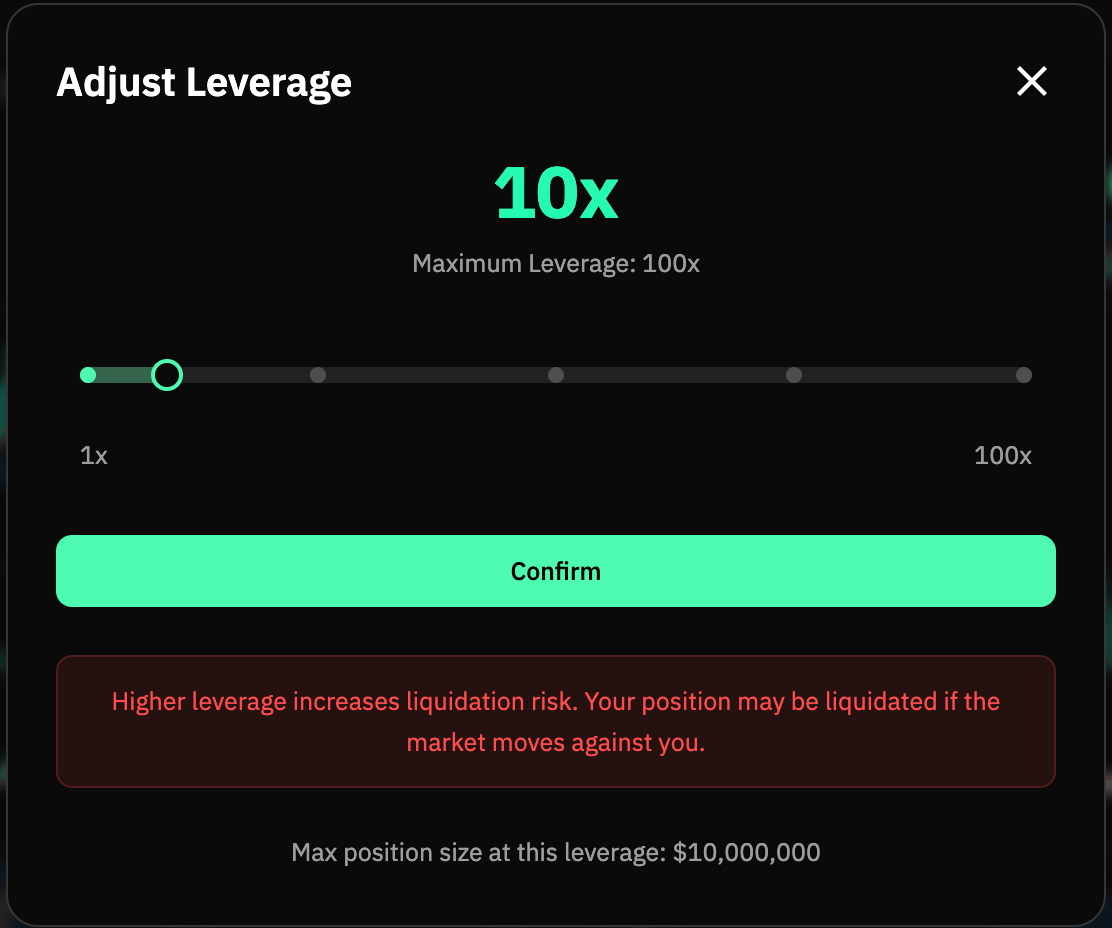
The leverage box on Strike shows the setting for the market you are on. Each market has a cap, and it falls as positions grow. On Bitcoin the first tier allows up to 100x for positions up to $10,000; larger positions are capped lower.
Cross and isolated margin
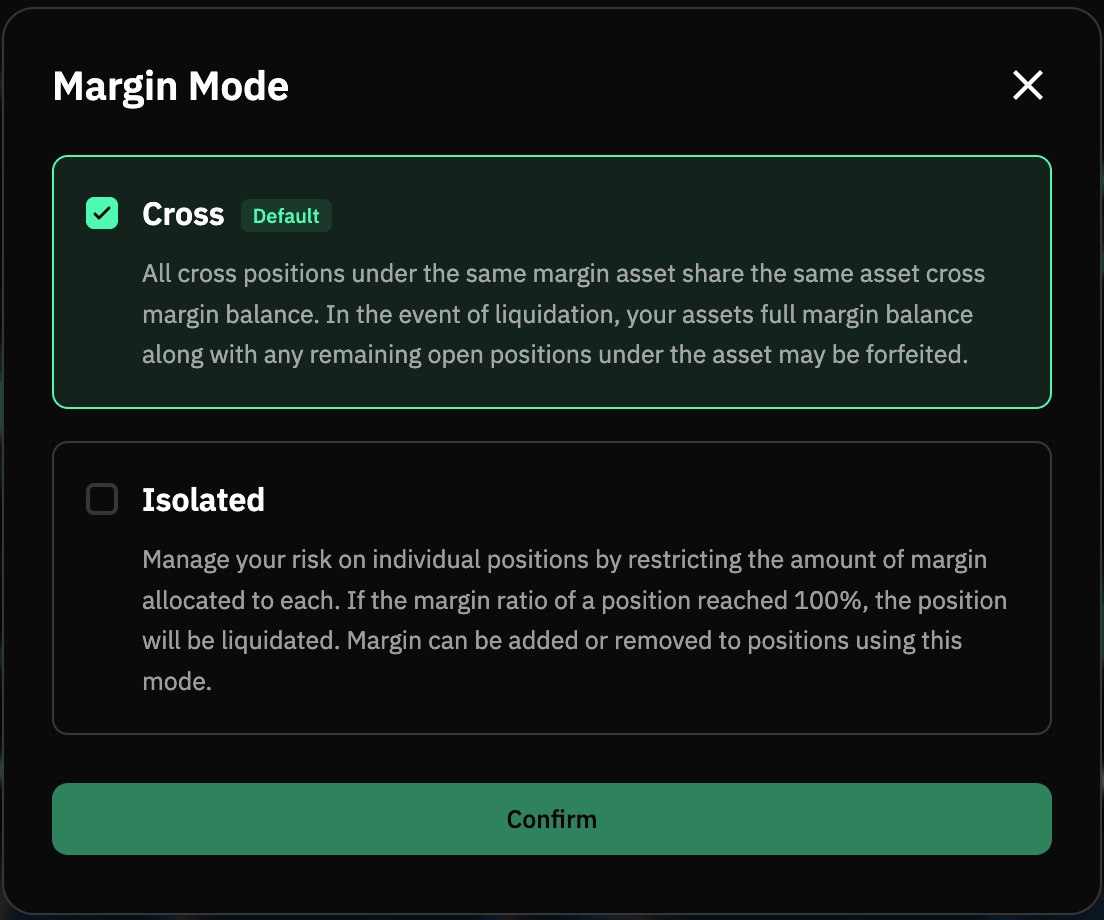
Strike has two margin modes, set per market. Cross margin, the default, lets every cross position draw on your whole account balance as its buffer. Isolated margin locks a fixed amount to one position, so only that amount is at risk. Cross keeps your liquidation price further away; isolated caps what one bad trade can cost.
Who it's for
- You want to make a small deposit go further. Leverage does that, and the next section shows what it costs when the price goes the other way.
- You think a price will fall. A short earns when it does, something a plain purchase cannot do.
- You run more than one position. Cross or isolated decides whether they share a buffer or stand alone.
How to set leverage and margin mode on Strike
- Open a market on the Trade page. The order panel sits on the right.
- The top row shows the margin mode, Cross or Isolated, and the leverage, for example 10x. Click either to change it.
- Set the leverage with the slider or by typing a number. Lowering leverage always works; raising it may be refused if your position is already in a higher tier.
- Pick Long/Buy or Short/Sell, enter a size, and the panel shows the margin it will take and the estimated liquidation price before you confirm.
A worked example
This is an example, not a suggestion. Say you put $100 behind a long on Bitcoin and the price moves 5%.
| Leverage | Position size | Price +5% | Price −5% |
|---|---|---|---|
| 1x | $100 | +$5 | −$5 |
| 2x | $200 | +$10 | −$10 |
| 10x | $1,000 | +$50 | −$50 |
| 20x | $2,000 | +$100 | −$100 |
At 20x the 5% drop costs the whole $100. In practice the exchange closes the position a little before that point, which is what the next guide is about. A short behaves the same way with the signs reversed.
Things worth knowing
- Leverage does not change the odds. It changes how much each move is worth, both ways.
- Fees scale with position size, not margin. Strike's base taker fee is 0.050% of the position's value, so a $1,000 position pays ten times the fee of a $100 one.
- Funding scales the same way. The hourly funding payment is worked out on the full position.
- Cross margin puts the whole account on the line. One losing position can draw down the balance that other positions rely on. Isolated margin stops that, at the cost of a closer liquidation price.
Questions people ask
Can I lose more than my margin?
With isolated margin, the amount locked to that position is what is at risk. With cross margin the position can draw on your whole account balance.
Is 1x leverage the same as buying the coin?
Close, but not the same. You hold a contract that follows the price, you pay or receive hourly funding, and you never hold the coin itself.
Which margin mode does Strike use if I do nothing?
cross margin, set per market. You can switch any market to isolated from the order panel.
Does changing leverage move my liquidation price?
Yes. Higher leverage means less margin behind the same position, so the liquidation price sits closer to your entry.
Next
- Next: Liquidation, and how to avoid it (Start here, part 4, coming)
- Before this: What is a perp?
- Official docs: Margin Modes and Margin Tiers
- Try it: open Strike (my referral link, 5% off fees)
Not financial advice.