Start here · 2 of 5
What is a perp? Perpetual futures explained in plain English
A perpetual future follows a price and never expires. What that means, how hourly funding keeps it close to the real price, and how to find a market on Strike.
Not affiliated with Strike. Not financial advice.
In one minute
- What it is: a perp is a contract that tracks the price of something, such as Bitcoin or gold, and never expires. You trade the price move, not the asset.
- Who it's for: people who want to profit from a price going up or down without buying the coin, the share or the metal itself.
- The one thing to know: you never own the asset. Small hourly payments called funding keep the contract near the real price, and with leverage a bad move can close your trade.
What is a perp?
A future is an agreement to trade something at a set price on a set date. A perpetual future, or perp, drops the date. The contract keeps running for as long as you hold it, and its price follows the asset it is named after.
On Strike, a BTC-USD perp follows the price of Bitcoin. If you think the price will rise, you go long: you profit as it climbs. If you think it will fall, you go short: you profit as it drops.
Either way you never hold any Bitcoin. Your position is a number on the exchange, backed by the dollars in your account.
What keeps the price honest?
Nothing forces a perp to match the asset on its own, so exchanges use funding. The exchange compares the perp's price with an index price, a reference built from the asset's price on other venues. When the perp trades above the index, longs pay shorts a small fee; when it trades below, shorts pay longs. On Strike, funding is settled every hour, on the hour.
The payments are tiny per hour. In Strike's own example, the rate is 0.00125% an hour. On a $100 position that is about a tenth of a cent, paid or received, every hour.
| Term | Meaning |
|---|---|
| Long | You profit when the price rises |
| Short | You profit when the price falls |
| Index price | The asset's price elsewhere, used as the reference |
| Mark price | The price Strike uses to value your position |
| Funding | Hourly payment between longs and shorts |
Who it's for
- You want to trade a move, not hold the asset. No wallet for the coin, no broker for the share, no vault for the gold.
- You want to be able to go short. A spot purchase only profits when prices rise. A perp lets you take the other side.
- You want one account for different things. On Strike the same balance trades crypto, stocks, indices and commodities.
How to find a market on Strike
- Open app.strikefinance.org and sign in with your wallet.
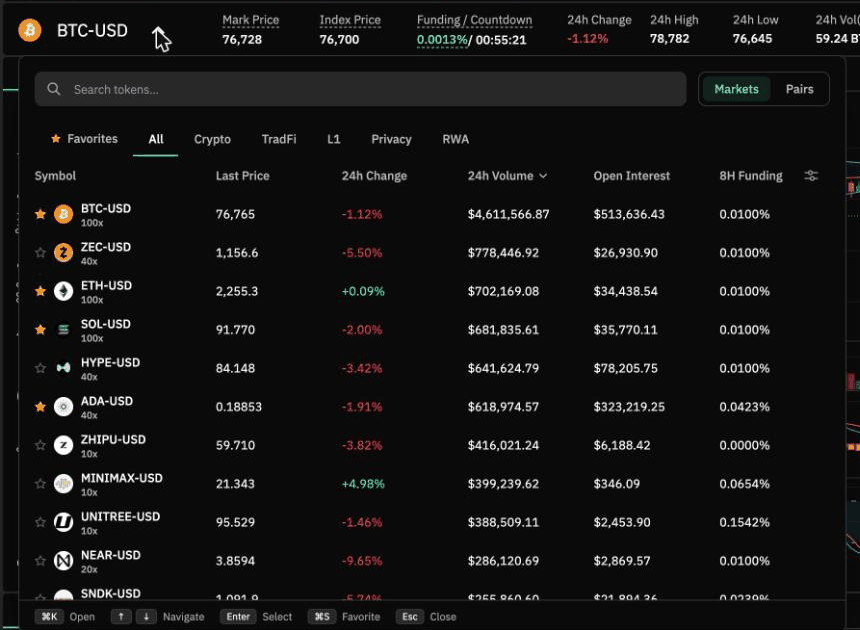
- Click the market name at the top left of the Trade page, BTC-USD by default. A list opens.
- Use the tabs to narrow it: Crypto, TradFi for stocks, indices and commodities, and a search box for a name.
- Each row shows the last price, the 24-hour change, the volume and the funding rate on its 8-hour basis. Pick one and the chart and order panel switch to it.
A worked example
This is an example, not a suggestion. Say you open a $100 long on the BTC-USD perp with no leverage, and Bitcoin rises 5%. Your position is now worth about $105. Close it and you keep the $5, less a small trading fee on the way in and out.
If Bitcoin had fallen 5% instead, closing would leave you about $95.
A short works in reverse. Open a $100 short, and a 5% fall earns about $5 while a 5% rise loses about $5. Funding adds or takes a fraction of a cent an hour while the position is open.
Things worth knowing
- Funding runs both ways. Depending on the market, you may pay or receive it. The list shows each market's 8-hour rate, and Strike settles one eighth of it every hour.
- Fees are small but real. Strike's base fee for taking liquidity is 0.050% of the trade's value, and placing a resting order earns a 0.005% rebate.
- Leverage changes everything. The examples above use none. With leverage a smaller move produces the same gain or loss, and a large enough move closes the trade. That is the next two guides.
Questions people ask
Do I own any Bitcoin when I buy a BTC perp?
No. You hold a contract that follows Bitcoin's price, backed by the dollars in your Strike account.
When does the contract expire?
It does not. A perp runs until you close it or it is closed for you, which part 4 of this series explains.
Can I profit when prices fall?
Yes. Going short on a perp earns when the price drops, and loses when it rises.
Why is the perp's price slightly different from the real price?
The perp trades on its own order book, so it drifts. Hourly funding pulls it back towards the index price.
Next
- Next: Long, short and leverage (Start here, part 3, coming)
- Then: Liquidation and how to avoid it, Your first trade on Strike.
- Official docs: Funding Rates and Prices
- Try it: open Strike (my referral link, 5% off fees)
Not financial advice.